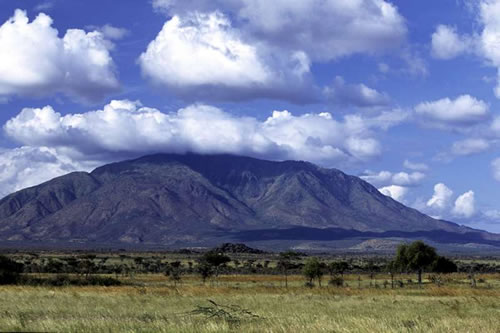
 Mt. Elgon boasts the world's biggest volcanic base, covering 4,000 square kilometers. It is the oldest and largest isolated volcanic mountain in East Africa, located on the Uganda-Kenya boundary. Its massive size, reaching 80 kilometers in a circle, soars more than 3,000 meters over the surrounding plains.
Elgon is named after the Maasai name OlDoinyoIlgoon ('Breast Mountain'), and it contains five major peaks, the tallest of which is Wagagai (4,321m) on the Ugandan side. It is Uganda's second-highest peak (after Mount Stanley at 5,109m) and Africa's ninth. The fall into the enormous 40km2 caldera, rather than the last ascent to the 4,321m Wagagai Peak, is the ultimate aim of reaching Mt. Elgon's top.
The woods give way to heath and eventually to afro-alpine moorland as you reach the peak. Rare plant species thrive on the moorland, including the gigantic groundsel and the one-of-a-kind Lobelia elgonensis. Duikers forage among the lush grass while endangered Lammergeier vultures fly above. The highest slopes are protected by national parks in Uganda and Kenya, forming a huge transboundary conservation area designated as a UNESCO Man & Biosphere Reserve.
The slopes of this large extinct volcano are home to several monkeys and over 300 bird species, including the endangered Lammergeyer, the uncommon Jackson's francolin, the alpine chat, and the white-starred forest robin. Bigger animals, such as leopards, hyenas, buffalo, and elephants, are more difficult to see. The vast majority of people come to trek and marvel at the breathtaking scenery.
Other activities include:
- Cultural outings - Bagisu and Sabiny, with the downtrodden Ndorobos imprisoned in Benet's woodland. The Bagisu, also known as the BaMasaba, consider Mount Elgon as a manifestation of their founding father Masaba.