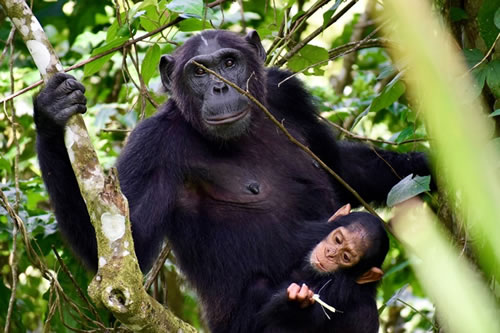
 Kibale National Park is located 345 kilometers southwest of Kampala in Uganda. This deep tropical rainforest park, near Fort Portal, is one of Uganda's smallest parks, measuring only 795 square kilometers. Its highest point is 1,590m above sea level at its northernmost tip. The Albertine Rift Valley level drops to 1,100m to the south. Its varied elevation supports a wide range of ecosystems, including a wet tropical forest on the Fort Portal plateau and woodland and savanna on the rift valley floor.
Its varied flora includes 351 recognized tree species, some of which may grow to heights of more than 55 meters and can live for more than 200 years.
This makes it an especially good habitat for the many chimps who dwell among the other 12 primates and 57 species of wildlife. Following one of the five habituated chimp groups is a less difficult but equally rewarding expedition than Bwindi Impenetrable Forest. The rare red colobus and L'Hoest's monkeys can also be seen here. Larger but seldom observed animal residents include bushbucks, sitatungas, buffaloes, leopards, and forest elephants. In addition to the crested guineafowl, great blue turaco, grey parrot, Green-breasted and African pittas, African crowned eagles, and black bee-eaters, this park has 250 butterfly species and 372 bird species.
Kibale National Park borders Queen Elizabeth National Park to the south, establishing a 180-kilometer-long wildlife corridor between Ishasha, Queen Elizabeth National Park's isolated southern part, and Sebitoli, north of Kibale National Park. One of Uganda's most fascinating exploration areas is the Kibale-Fort Portal region. The park is in the tranquil Ndali-Kasenda crater area and is only a half-day drive from Queen Elizabeth, the Rwenzori Mountains, and the Semuliki National Parks, as well as the Toro-Semliki Wildlife Reserve.
Additional activities include:
- Hiking in the woods
- Cultural outings