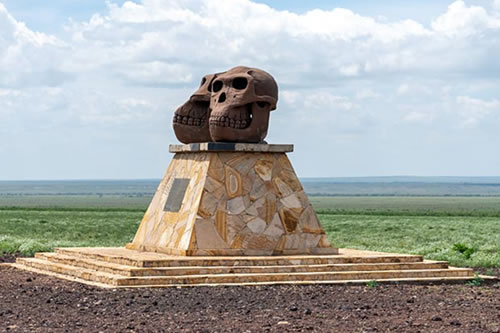
 Olduvai Gorge, located in the Ngorongoro Conservation Area on the road from Ngorongoro Crater to Serengeti Park, is thought to be the birthplace of man and has provided some of his earliest relics. The bones are believed to have been discovered by a German entomologist while out hunting for butterflies! The German government was unable to sustain the excavation project due to the start of World War II, and the funds were ultimately shifted to the war effort. Years later, the Leakey family's research at the location reintroduced the Olduvai Gorge to the public eye. This remote spot became famous as the place where Dr. Mary Leakey discovered Australopithecus Boisei 1.5 million years ago, in 1959.
A modest but fascinating museum overlooking the valley displays some of the prehistoric man's skulls, bones, and tools unearthed in the canyon, as well as a large collection of animal fossils that represent the shape and size of today's species two million years ago. Animal bones recovered were those of an old elephant and giraffe, a massive ostrich, and a large horned sheep. The seemingly gentle OlDuvai River continues to erode the land, revealing significant fossils that aid archaeologists and paleontologists in developing a better understanding of the origins of modern man and the creatures that inhabited this part of the world, particularly at Olduvai Gorge and Laetoli.
FAQ: What is Olduvai Gorge famous for?/Where is Olduvai Gorge found?
The gorge is regarded as the "Cradle of Mankind" since it was the site of the discovery of the first human remains on Earth. It is located in the Ngorongoro Conservation Area on the road from Ngorongoro Crater to Serengeti Park
Who discovered the oldest human skull at Olduvai Gorge?/What did Leakeys discover in Olduvai Gorge?
Dr. Leaky and her husband discovered the oldest human skull know as Australopithecus Boisei 1.5 million years ago, in 1959at Olduvai Gorge